


Coalition 2030’s Steering Committee member Catherine Carty spoke today at a School of International futures side event at the United Nations High Level Political Forum. The theme of the meeting was “From Declaration to Delivery: How Future Generations Governance Drives Transformative SDG Action” and Catherine spoke of our work around the Call to Action Report and subsequent calls for a Future Generations Commission for Ireland. Here is the text of her speech
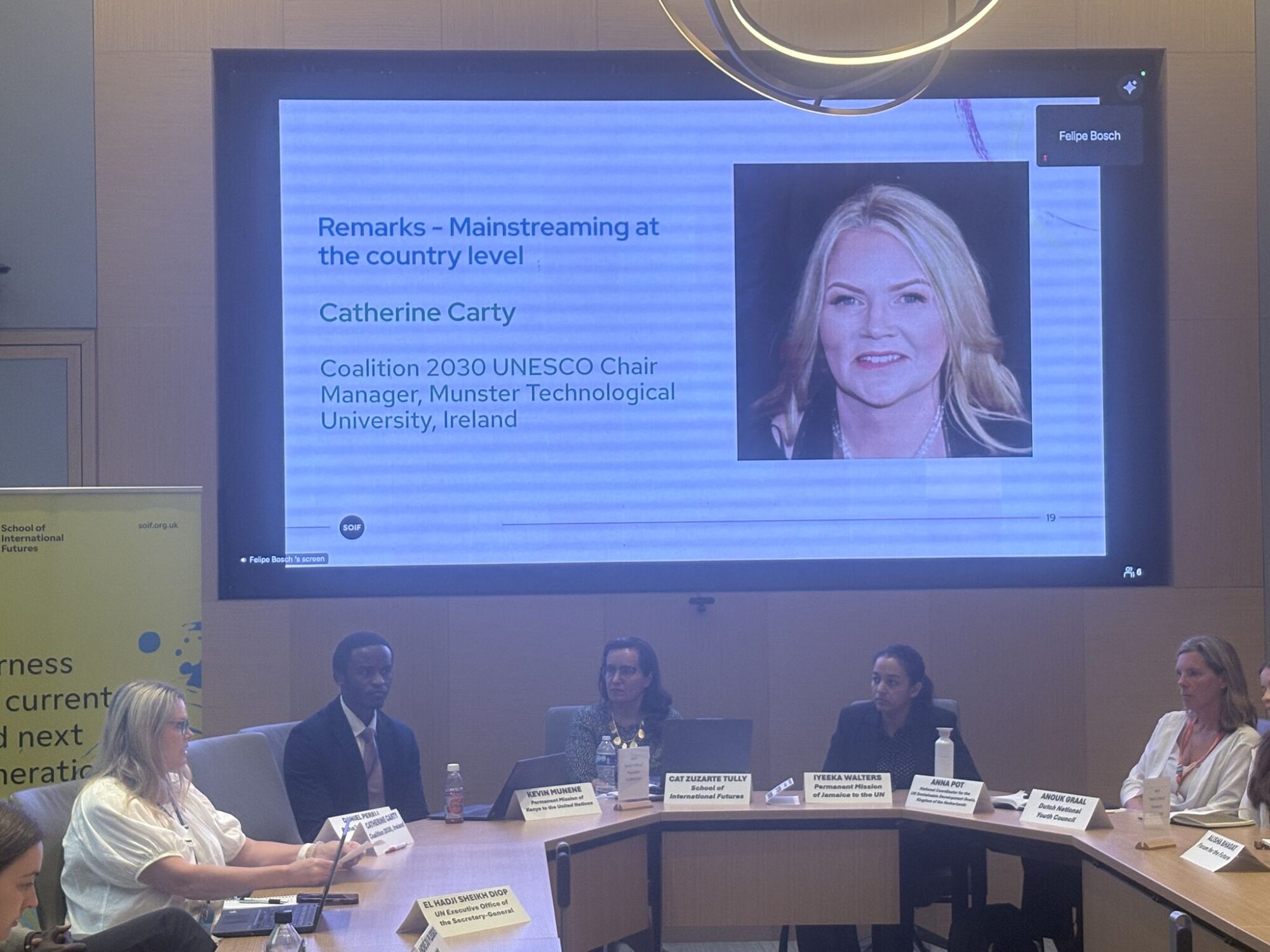
Thank you, Ambassador Monari, Cat, and colleagues, and thank you to the School of International Futures for convening this dialogue.
I am Catherine Carty, representing Coalition 2030, a broad Irish civil-society alliance working to advance the Sustainable Development Goals. Our coalition brings together international development, domestic, anti-poverty and equality, environmental, trade-union, arts and culture and academic perspectives. That breadth matters because decisions affecting future generations reach across every area of public policy.
Ireland has a particular connection to this agenda. Ireland and Kenya co-facilitated the negotiations on the 2030 Agenda, while Irish leaders, including Mary Robinson and David Donoghue Co-Chair of the SDGs, have long championed intergenerational equity. The Declaration on Future Generations now calls for strategic foresight, forward-looking impact assessment, whole-of-government coordination, whole-of-society participation and futures literacy. Ireland’s task is to connect these principles to the everyday government actions.
In 2024, Coalition 2030’s launched A Call to Action for Future Generations. Developed through broad and extensive consultation across civil society, public administration, politics and international practice, it calls for an independent Future Generations Commissioner for Ireland.
It also proposes a practical pathway: a taskforce, an inclusive scoping process, cross-party ownership, protected resources, legislation and direct accountability to the Irish National Parliament.
Coalition 203 strongly supports the work initiated in the parliament by Deputy Marc Ó Cathasaigh for the Green Party in Ireland. His Commission for Future Generations Bill provides an important legislative pathway. It proposes an independent commission to examine how to establish an Ombudsman for Future Generations, drawing on Ireland’s Well-being Framework and considering challenges including climate and biodiversity, demographic change, care, public health, and intergenerational inequality.
His core proposition was simple: future people count.
We have also moved in Ireland from advocacy to collective design.
Momentum is building in Ireland. In March 2026, Coalition 2030 participated in the Governing for the Future: Institutions and Practices workshop at University College Dublin with UCD’s Centre for Innovation, Technology and Organisation, School of International Futures, Well Beng Economy Alliance Hub Ireland and FEASTA.
The workshop brought together participants from government, politics, academia, civil society and business to develop a roadmap for long-term governance. The emerging package includes parliamentary scrutiny, further support for a Future Generations Commissioner, a participatory national vision, futures capability across the civil service and education, and stronger links between wellbeing, budgeting and accountability.
We value SOIF’s support for the Irish Long-Term Governance Hub and its practical focus on citizens, institutions and leaders moving together. Coalition 2030 is an active member of the International Long Term Governance Hub.
I would offer three lessons from this Irish experience.
First, build an ecosystem around a trusted institutional anchor.
A Future Generations Commissioner can provide continuity, independent challenge and a clear voice for future interests. The wider ecosystem should connect parliament, central and local government, public administration, research, civil society and citizens. These elements reinforce each other and create resilience across political and electoral cycles.
Second, connect future generations work to the core machinery of the State.
Long-term commitments need clear routes into legislation, budgets, policy appraisal, national planning, measurement and parliamentary accountability. Ireland already has useful foundations in the SDGs, the Well-being Framework, citizens’ assemblies and national foresight initiatives. Their influence will grow when they are linked directly to decisions and resource allocation.
Forward-looking impact assessments and measures of progress beyond GDP can help make the consequences of present-day choices visible before those choices become embedded.
Third, invest in capability and participation together.
Public officials and political leaders need practical skills in foresight, systems thinking and futures literacy. Citizens need continuing opportunities to shape shared visions, consider trade-offs and see how their contributions influence decisions.
Ireland’s experience with citizens’ assemblies provides a strong foundation for deliberation. The next phase should develop sustained forms of participation involving children and young people, older people, persons with disabilities and communities most affected by long-term risks.
On 22 September 2026, Coalition 2030 will host a further national event at Buswell’s Hotel in Dublin, chosen to make participation by government and parliamentary stakeholders as practical as possible. Our aim is to move from the roadmap towards commitments, partnerships and an implementable sequence of action.
Ireland’s central lesson is practical: connect existing assets, create a shared long-term vision, establish an independent institutional anchor and build future-oriented practices into routine decisions.
Future generations governance is ultimately the discipline of making better decisions today.
The test is whether people in 2050 inherit stronger institutions, a fairer society and a healthier planet because of the choices we take now.